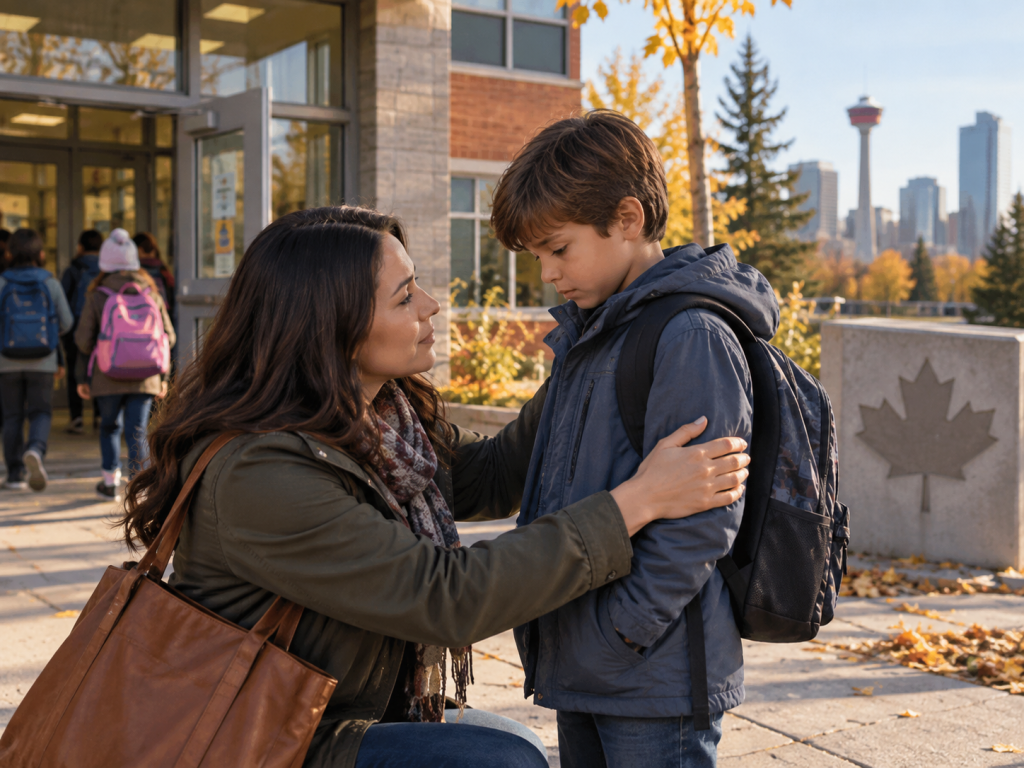
Back-to-school stress can tip Calgary kids into anxiety or depression. Learn the signs by age, what to do at home, and when to call a child counsellor.
Back-to-school anxiety is the spike in worry, dread, and physical stress symptoms many children and teens experience in the first six to eight weeks of a new school year — and in Calgary, that window is right now. Classes at the Calgary Board of Education and Calgary Catholic School District resumed at the start of September, and the honeymoon period is over: the new teacher is no longer new, the friend group has settled (with or without your child), and the first assessments are landing. For most kids, the nerves fade by Thanksgiving. For a meaningful minority, September is the month a treatable anxiety or depressive episode takes hold, and October is when parents start searching for child counselling in Calgary.
Why Back-to-School Is Harder on Kids Than Parents Expect
A new school year is not one change. It is a dozen simultaneous changes to a child’s routine, relationships, and demands — and a developing nervous system experiences that stack as threat.
Consider what actually shifts in the first two weeks of September for a Calgary kid. Wake-up time moves earlier by one to two hours after a summer of late sunsets. Unstructured play is replaced by six hours of sitting, listening, and being evaluated. Social status resets: the groups that formed in June don’t always survive the summer, and a child who was comfortable in Grade 6 may be the smallest person in a Grade 7 hallway. Academic expectations jump, especially at the Grade 4, Grade 7, and Grade 10 transitions. Extracurriculars restart at the same time, and summer screen time is suddenly restricted and contested.
Each change is manageable on its own. Together, they raise a child’s baseline stress load at exactly the moment they have the least control over their day. Kids who are temperamentally cautious, kids with ADHD or learning differences, kids who moved schools, and kids whose home life changed over the summer carry that load with less margin.
The broader context matters too. Statistics Canada’s 2023 Canadian Health Survey on Children and Youth found that the share of young people rating their own mental health as “fair” or “poor” more than doubled between 2019 and 2023, from 12% to 26%, with girls (33%) faring worse than boys (19%). The Canadian Institute for Health Information notes that roughly 70% of people who develop a mental illness experience their first symptoms before age 18. The school transition doesn’t create these vulnerabilities, but it is one of the most reliable triggers for them.
Stress, Anxiety, or Depression? How to Tell the Difference
Back-to-school stress fades as the routine settles; anxiety persists and starts generating its own triggers; depression shows up as a loss of interest and energy that doesn’t lift even on good days. The distinction matters because the responses are different.
Normal adjustment stress looks like a few rough mornings, some tears at drop-off, tiredness, and irritability in the first two or three weeks. Your child still enjoys things outside school, still sleeps reasonably well, and settles once the day is underway. This resolves on its own with routine, sleep, and reassurance.
School anxiety is stress that outlasts the adjustment period, or is out of proportion to what’s happening. The worry is anticipatory and specific: the presentation on Thursday, whether anyone will sit with them at lunch, whether they’ll be called on. It comes with physical symptoms — stomach aches, headaches, nausea, trouble falling asleep on Sunday nights — and with avoidance. Anxious kids negotiate hard to stay home, ask endless “what if” questions, and need more reassurance than reassurance can provide. If this describes your child past the four-week mark, you’re looking at anxiety in a child, not a slow adjuster.
Depression in kids and teens often gets missed because it doesn’t look like adult sadness. It looks like irritability, withdrawal, flat affect, “I don’t care,” dropping the activities they used to love, sleeping too much or barely at all, and a change in appetite. The key difference from anxiety is direction: anxiety is about fear of what’s coming; depression is about the absence of anything worth looking forward to. The two frequently co-occur, and untreated school anxiety in September is one of the common paths to a depressive episode by November.
Signs of Back-to-School Anxiety by Age
Anxiety shows up differently at 6, at 11, and at 16. Parents most often miss it when they’re watching for the wrong age’s symptoms.
Ages 5–9: Early elementary
Young children rarely say “I’m anxious.” They say “my tummy hurts.” Watch for morning stomach aches and headaches that vanish on weekends, clinginess at drop-off that gets worse rather than better over the first weeks, regression to earlier behaviours (bedwetting, thumb-sucking, baby talk), new fears of the dark or of being alone, meltdowns after school that seem disproportionate (a sign they’ve been holding it together all day), and repeated questions about the schedule, who’s picking them up, and what happens if something goes wrong.
Ages 10–13: Late elementary and junior high
This is the group most affected by the social reset, and Calgary’s junior high transition at Grade 7 is a known pressure point. Look for Sunday-night dread and Monday-morning illness, refusal to talk about their day, sudden concern about appearance and clothes, perfectionism about assignments or, conversely, avoidance of homework entirely, withdrawal from friends they were close to in June, and phone or gaming use that has become an escape rather than a hobby.
Ages 14–18: High school
Teens hide anxiety behind irritability and independence. Warning signs include skipping classes or entire days, a drop in grades that doesn’t match effort, panic symptoms before tests or presentations (racing heart, shaking, feeling faint), social withdrawal framed as “I just don’t like those people anymore,” changes in eating, and new or increased substance use. The risk of anxiety tipping into depression is highest in this group, and teens are least likely to tell you directly.
Signs of Depression in Kids and Teens After School Starts
The signs of depression in teens and younger children after the school year begins are a sustained change from their normal self lasting two weeks or more: persistent irritability or sadness, loss of interest in things they used to enjoy, withdrawal from family and friends, changes in sleep and appetite, difficulty concentrating, expressions of worthlessness or guilt, and in some cases talk of self-harm or not wanting to be here.
A useful parental test: has your child lost interest in things that have nothing to do with school? A kid who dreads math class but still lights up at hockey practice is probably anxious. A kid who has stopped caring about hockey too is showing something more global.
Depression in children and teens responds well to treatment, and earlier is markedly better than later. If you’re seeing these signs, Curio Counselling’s depression counselling in Calgary team works with kids and teens as well as adults. If your child mentions self-harm or suicide, take it seriously every time: call 988 (Canada’s Suicide Crisis Helpline, available 24/7 by call or text), contact the Alberta Mental Health Help Line at 1-877-303-2642, or go to the Alberta Children’s Hospital emergency department.
School Refusal: When “I Don’t Want to Go” Becomes a Pattern
School refusal is persistent, emotionally driven difficulty attending school — not truancy, and not laziness. The child genuinely cannot make themselves walk through the door, and the distress is real. It affects an estimated 1–5% of school-age children, peaks at transition years, and almost always has anxiety, depression, or both underneath it.
School refusal starts small: a request to stay home “just today,” a stomach ache at 7:45 a.m., a late arrival. Each day at home brings relief that is intensely reinforcing, and the next morning is harder. Within a few weeks, a pattern is established that is difficult to break without help.
What works is early, calm, consistent action. Keep the child in school, even for partial days, rather than allowing full absences. Work with the school (most CBE and Calgary Catholic schools have a counsellor, learning support teacher, or family liaison who has seen this many times). Address the anxiety underneath through therapy rather than negotiating the attendance itself. What doesn’t work is punishment, lectures, or waiting for it to pass — school refusal rarely resolves on its own once established.
What Parents Can Do at Home This Month
Most back-to-school anxiety improves with structure and connection at home, well before therapy is needed. These are the strategies child therapists recommend most often, in rough order of impact.
Protect sleep first. Nothing amplifies anxiety and low mood in children faster than a sleep deficit. Elementary kids need 9–12 hours, teens 8–10. Move bedtimes earlier in 15-minute steps, get screens out of the bedroom, and hold the schedule on weekends within an hour.
Front-load predictability. Anxious kids do better when they can see the day coming. A visible weekly calendar, a consistent morning routine, and a two-minute preview of tomorrow at bedtime reduce the “what if” spiral.
Ask about feelings, not performance. “How was school?” gets “fine.” “What was the hardest part of today?” or “Who did you sit with at lunch?” gets information. Ask in the car or while doing something side-by-side — kids talk more when they’re not being looked at.
Name the feeling and normalize it. “It makes sense that you’re nervous about the new class. Lots of kids feel that way in September.” Validation lowers the intensity. Dismissal (“There’s nothing to worry about”) raises it.
Don’t accommodate the avoidance. This is the hard one. When you let an anxious child skip the thing they fear, their anxiety about it grows. Support them to do the scary thing in small steps — walk them to the classroom door, then the hallway, then the school entrance — and praise the attempt, not the outcome.
Watch your own stress. Kids borrow their parents’ nervous system. A calm, matter-of-fact parent at drop-off does more than any pep talk.
When to Seek Counselling for Your Child
Book a consultation when the symptoms have lasted more than three to four weeks, are getting worse rather than better, are interfering with school attendance, sleep, eating, or friendships, or when your child has said anything about self-harm. You do not need a diagnosis, a doctor’s referral, or a crisis to see a child therapist in Alberta.
Parents often wait because they’re unsure whether it’s “bad enough.” A more useful question is whether it’s affecting your child’s daily functioning. If mornings are a battle every day, if they’ve stopped seeing friends, if you’ve had three calls from the school, a therapist can help.
What therapy for school anxiety and depression looks like at Curio Counselling
Curio Counselling provides child and youth counselling in Calgary for kids and teens ages 3 to 19, in person at our Beltline office at 1414 8 St SW Suite 200 and online across Alberta. The approach is matched to age: play therapy and art therapy for younger children who can’t yet put anxiety into words, and talk-based cognitive behavioural therapy (CBT), the first-line evidence-based treatment for both anxiety and depression, for older children and teens. Our team includes Registered Psychologists regulated by the College of Alberta Psychologists and Canadian Certified Counsellors registered with the CCPA, several of whom specialize in children, adolescents, and school-related concerns.
Parents are part of the process, not spectators. For younger children, sessions typically include parent coaching so the strategies continue at home; for teens, we balance the teen’s need for a confidential space with keeping parents informed and involved. Where anxiety at school is tangled up with attention or learning differences, our ADHD therapy team is part of the same practice, and where the stress is family-wide, family counselling is available too.
Sessions are 50 minutes and cost $200 with a Canadian Certified Counsellor or $230 with a Registered Psychologist or Registered Provisional Psychologist. Most Alberta workplace benefit plans cover our services, and we offer direct billing to many insurers. Evening appointments until 8 p.m. on weekdays and Saturday hours mean you don’t have to pull your child out of school to get help.
Book a free 20-minute consultation and we’ll match your child with a therapist, usually within the same week.
Frequently Asked Questions
How long does back-to-school anxiety usually last?
For most children, back-to-school anxiety settles within two to four weeks as routines become familiar. If symptoms persist past the four-week mark, worsen, or begin interfering with attendance, sleep, or friendships, it has moved beyond normal adjustment and is worth addressing with a child therapist.
Is it normal for my child to cry at school drop-off in September?
Yes, particularly for children in kindergarten through Grade 2 and for any child starting a new school. Drop-off tears that shorten and lessen over the first two weeks are normal separation stress. Tears that intensify, spread to the whole morning, or are accompanied by physical complaints and pleading to stay home point to separation anxiety that benefits from support.
What is the difference between school anxiety and school refusal?
School anxiety is the worry and physical distress a child feels about school; school refusal is the behavioural result when that distress becomes severe enough that the child cannot attend. Not every anxious child refuses school, but nearly every case of school refusal has anxiety, depression, or both underneath it. Refusal is treated by addressing the anxiety, not by negotiating attendance.
Can back-to-school stress cause depression in kids?
It can contribute to it. Prolonged stress, social isolation, academic failure, and untreated anxiety are all recognized risk factors for a depressive episode in children and teens, and the school transition brings several of them at once. Early intervention for anxiety in September is one of the best ways to reduce the risk of depression later in the school year.
Should I keep my anxious child home from school?
Generally, no. Staying home provides short-term relief that reinforces the anxiety and makes the next day harder. The exception is a genuine illness or an acute crisis. For anxious children, partial days, a gradual re-entry plan, and a therapist working on the anxiety itself produce far better outcomes than time off.
Does my child need a referral to see a counsellor in Calgary?
No. In Alberta, you can book directly with a Registered Psychologist or Canadian Certified Counsellor without a physician referral. Curio Counselling offers a free 20-minute consultation to match your child with a therapist.
What kind of therapy works best for school anxiety in children?
Cognitive behavioural therapy (CBT) has the strongest evidence base for childhood anxiety and is the recommended first-line psychological treatment. For younger children, play therapy and art therapy deliver the same principles in a developmentally appropriate form. Parent involvement improves outcomes at every age.
Author Profile

- Canadian Certified Counsellor, Counselling Therapist
- I hold a Master of Counselling in Applied Psychology with a Specialization in Counselling Psychology from the University of Lethbridge, as well as bachelor’s degrees in English Literature and Education. I have additional training in religious trauma, ADHD, grief & loss, trauma & PTSD, play therapy techniques, parts work, and creating inclusive spaces.
Latest entries
 BlogSeptember 12, 2026Lying by Omission: Why Silence Hurts More Than the Lie (and How to Rebuild Trust)
 BlogSeptember 12, 2026Co-Parenting Counselling After Separation: Your Guide to Peaceful Co-Existence
 BlogSeptember 12, 2026Triangulation in Emotional Abuse: How to Recognise It and Break the Pattern
 BlogSeptember 12, 2026CBT vs. DBT: Which Therapy Is Right for You? A Calgary Therapist’s Guide | Curio Counselling


